
Understanding IUI vs IVF Difference to Find Your Path to Parenthood - Samad Hospital
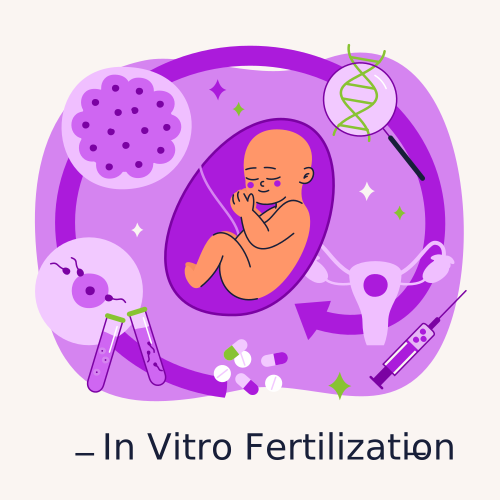
Every individual and couple has a unique story, and there is no one-size-fits-all answer when it comes to fertility care. Some paths are straightforward, while others require more advanced technology. By looking into these options, you are taking a proactive and loving step towards your future. This guide is designed to walk you through the nuances of these treatments in a way that feels like a chat with a trusted friend, ensuring you have the knowledge to discuss your next steps with a specialist.
What Exactly Is IUI and How Does It Work
Intrauterine Insemination, or IUI, is often one of the first treatments suggested because it is relatively simple and stays quite close to the body’s natural processes. In this procedure, specially prepared sperm is placed directly into the uterus around the time of ovulation. The goal is to give the sperm a head start by shortening the distance it needs to travel to reach the egg.
This method is frequently recommended for couples dealing with unexplained infertility or for those using donor sperm. It is a gentle approach that involves minimal intervention. During a typical cycle, a healthcare provider might monitor your natural ovulation or use mild medications to encourage the growth of one or more eggs. Because the procedure is quick and involves little discomfort, many people feel at ease choosing this as their starting point.
The beauty of IUI lies in its simplicity. It requires fewer medications than more intensive treatments and is generally more affordable. However, it does rely on the fallopian tubes being healthy and open, as the actual fertilisation still happens naturally inside the body. Understanding this part of the IUI vs IVF difference helps in managing expectations regarding how much the medical team intervenes in the biological process.
Diving Into the World of IVF
In Vitro Fertilisation, commonly known as IVF, is a more robust and highly successful treatment that involves several stages. Unlike IUI, where fertilisation happens inside the mother, IVF involves joining the egg and sperm in a specialised laboratory. This allows the clinical team to monitor the early stages of development very closely before placing a healthy embryo back into the uterus.
The process begins with ovarian stimulation, where medications are used to encourage the ovaries to produce several eggs. These eggs are then gently retrieved during a minor procedure. Once the eggs are fertilised in the lab, they are observed for a few days to ensure they are growing as expected. One or more of these embryos are then transferred to the uterus, with the hope that they will nestle in and begin a healthy pregnancy.
IVF is often the preferred choice when there are concerns such as blocked fallopian tubes, severe male factor infertility, or if other treatments have not been successful. It offers a higher degree of control and generally higher success rates per cycle. While it involves more steps and a higher commitment of time and resources, the results have brought joy to countless families who thought parenthood might be out of reach.
Highlighting the Main IUI vs IVF Difference
When you compare these two paths, the most significant IUI vs IVF difference is where the magic of fertilisation actually takes place. In IUI, the sperm is simply placed in the right spot at the right time, but it must still find and fertilise the egg on its own inside the woman’s body. In IVF, the fertilisation is carefully managed by experts in a controlled environment.
Another key distinction is the level of medication and monitoring. IUI cycles are often quite low-key, requiring only a few visits and perhaps some light medication. IVF, on the other hand, involves a more structured schedule of injections and frequent ultrasounds to track egg development. This level of detail is what allows IVF to overcome more complex fertility challenges that IUI might not be able to address.
Success rates also form a part of the IUI vs IVF difference. Generally, IVF has a higher success rate per attempt because it bypasses many of the natural hurdles that can prevent pregnancy. However, because IUI is less invasive and less expensive, it remains a very popular and effective first choice for many. Your clinical team will look at your specific health history to help determine which statistical path aligns best with your goals.
Determining Which Path Suits Your Journey
Choosing between these treatments is a deeply personal decision that involves looking at your medical history, your budget, and your emotional readiness. For younger couples with unexplained infertility or those with minor sperm issues, starting with a few rounds of IUI is often a logical and comfortable choice. It feels less medicalised and allows for a more “hands-off” experience.
Conversely, if age is a factor or if there are known structural issues like damaged tubes, jumping straight to IVF might be the most efficient way to achieve a pregnancy. Many people find peace of mind in the advanced screening options available through IVF, such as checking embryos for genetic health before transfer. This extra layer of information can be incredibly reassuring for those who have experienced previous losses or have specific health concerns.
At Samad Hospital, the journey begins with a thorough consultation to understand your physical health and your heart’s desires. By evaluating hormone levels, tubal health, and sperm quality, a personalised plan is created. Whether the recommendation is a gentle IUI or a technologically advanced IVF cycle, the aim is always to find the path that offers you the best chance of success with the most comfort.
What to Expect During Your Treatment
Regardless of the path you choose, the experience is designed to be as smooth as possible. For an IUI cycle, you might visit the clinic just a few times. The actual insemination feels very similar to a routine cervical screening and takes only a few minutes. You can usually go about your day immediately afterwards, which makes it very easy to fit into a busy lifestyle.
For those embarking on IVF, the process is a bit more involved but is managed with expert care every step of the way. You will have a dedicated team to guide you through the medication schedules and the egg collection day. While the idea of “procedures” can sound a bit scary, modern techniques ensure that you are comfortable and well-cared for. Most patients find that the sense of community and support at the hospital makes the process feel much more manageable.
It is also worth noting that emotional support is a huge part of the process. Dealing with fertility can be a bit of a roller coaster, and having a team that treats you like a human being rather than just a patient makes all the difference. Knowing the IUI vs IVF difference helps you prepare mentally for the timing and nature of the appointments you will be attending.
Moving Forward With Confidence and Care
The path to parenthood is a brave journey, and having the right information acts as your essential map. While understanding the IUI vs IVF difference might seem technical initially, it essentially comes down to the level of assistance your body needs to create that first spark of life. Both methods are wonderful tools that have helped build many happy families. As you consider your options, remember to be kind to yourself. It is perfectly okay to have questions or to take the time you need to make a decision. The experts at Samad Hospital are dedicated to providing clinical excellence with a warm, human touch. Whether you are just beginning to explore your fertility or are ready to start a specific treatment, you are moving in the right direction. Stay positive, stay informed, and know that a supportive team is ready to help make your dreams a reality.
Leave a Comment