
IUI vs IVF: Which Fertility Treatment Is Right for You? - Samad Hospital
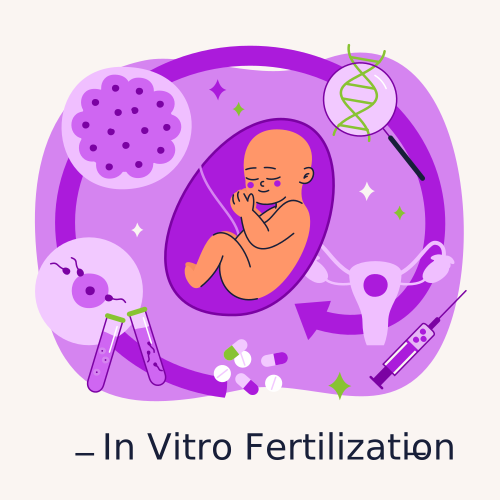
For couples beginning their fertility journey, one of the first and most confusing decisions is choosing between Intrauterine Insemination (IUI) and In-Vitro Fertilization (IVF). Both are proven, medically established treatments, but they differ significantly in procedure, cost, success rates, and the kinds of fertility challenges they address. Understanding these differences can help you have a more informed conversation with your fertility specialist and set realistic expectations for your treatment journey.
At Samad Hospital, South India’s first dedicated IVF centre, we guide hundreds of couples through this decision every year. This article breaks down how each treatment works, who it’s best suited for, and what factors typically influence the choice between them.
What Is IUI?
Intrauterine Insemination is a relatively simple and minimally invasive fertility procedure. During IUI, specially prepared and concentrated sperm is placed directly into the uterus around the time of ovulation, bypassing the cervix and shortening the distance sperm need to travel to reach the fallopian tubes. The procedure is typically timed using ovulation tracking, and in many cases, mild ovarian stimulation medication is used to encourage the release of one or two mature eggs.
IUI is usually recommended as a first-line treatment for:
- Mild male factor infertility (slightly low sperm count or motility)
- Unexplained infertility
- Ovulation disorders, when combined with fertility medication
- Couples using donor sperm
- Cervical mucus issues that make natural conception difficult
The procedure itself takes only a few minutes, requires no anaesthesia, and most patients resume normal activity immediately afterward. Success rates per cycle typically range between 10-20%, depending on age and underlying fertility factors, which is why IUI is often attempted for two to three cycles before considering a different approach.
What Is IVF?
In-Vitro Fertilization is a more advanced and comprehensive fertility treatment. It involves stimulating the ovaries to produce multiple eggs, retrieving those eggs through a minor surgical procedure, fertilizing them with sperm in a laboratory, and then transferring one or more resulting embryos back into the uterus. Our Reproductive Medicine (IVF) department uses advanced laboratory techniques, including ICSI (Intracytoplasmic Sperm Injection), to maximize fertilization rates even in complex cases.
IVF is generally recommended for:
- Blocked or damaged fallopian tubes
- Severe male factor infertility
- Diminished ovarian reserve or advanced maternal age
- Endometriosis
- Failed IUI cycles
- Genetic conditions requiring embryo screening
- Couples who need donor eggs, sperm, or a gestational carrier
Because IVF bypasses many of the natural barriers to conception, it generally offers higher success rates per cycle than IUI, particularly for patients over 35 or those with structural or severe fertility issues.
Key Differences at a Glance
| Factor | IUI | IVF |
|---|---|---|
| Invasiveness | Minimal | Moderate (egg retrieval procedure) |
| Where fertilization occurs | Inside the body | In the laboratory |
| Typical success rate per cycle | 10-20% | 30-45%, age-dependent |
| Best suited for | Mild fertility issues, unexplained infertility | Tubal blockage, severe male factor, advanced age |
| Monitoring required | Moderate | Intensive |
How Age Affects the Decision
Age is one of the most significant factors in choosing between IUI and IVF. Egg quality and quantity decline over time, particularly after age 35, which directly affects the success rates of both treatments. Younger patients with mild fertility issues often do well with IUI, while patients closer to or past their late thirties are frequently advised to move to IVF sooner, since time itself becomes a limiting factor. We’ve covered this in more depth in our guide on Female Fertility and Age, which explains how ovarian reserve changes over a woman’s reproductive years and what that means for family planning.
The Role of Male Fertility in the Decision
Sperm health plays an equally important role in deciding between IUI and IVF. Mild abnormalities in sperm count or motility can often be managed with IUI, but more significant male factor infertility usually requires IVF with ICSI, where a single healthy sperm is injected directly into an egg to achieve fertilization. If you’re trying to understand what your semen analysis results mean, our article on Male Infertility: Causes, Diagnosis, and Treatment Options walks through common causes and how they’re diagnosed.
Why a Personalized Diagnostic Workup Matters
Neither IUI nor IVF should be chosen in isolation — the right treatment depends on a thorough diagnostic evaluation, including hormone testing, ultrasound assessment of the ovaries and uterus, and a semen analysis for the male partner. Our Hormone Laboratory provides detailed fertility hormone panels that help our specialists understand ovarian reserve and hormonal balance before recommending a treatment path.
Cost Considerations
IUI is significantly more affordable than IVF, which makes it an attractive first step when medically appropriate. However, repeatedly attempting IUI when the underlying issue calls for IVF can end up costing more time and money in the long run without improving outcomes. This is why we recommend a data-driven approach: base the decision on your specific diagnostic findings rather than starting with the least expensive option by default.
Making the Right Choice for You
There is no single “better” treatment between IUI and IVF — the right choice depends entirely on your individual diagnosis, age, and fertility history. At our Fertility clinic, our specialists conduct a comprehensive evaluation of both partners before recommending a treatment plan, ensuring you don’t waste valuable time on a protocol that isn’t suited to your situation.
If you’re beginning your fertility journey and unsure which path is right for you, we encourage you to book a consultation with our reproductive medicine team. With over three decades of experience and South India’s first IVF centre, Samad Hospital is here to guide you toward parenthood with clarity, compassion, and evidence-based care.
Leave a Comment